Empire
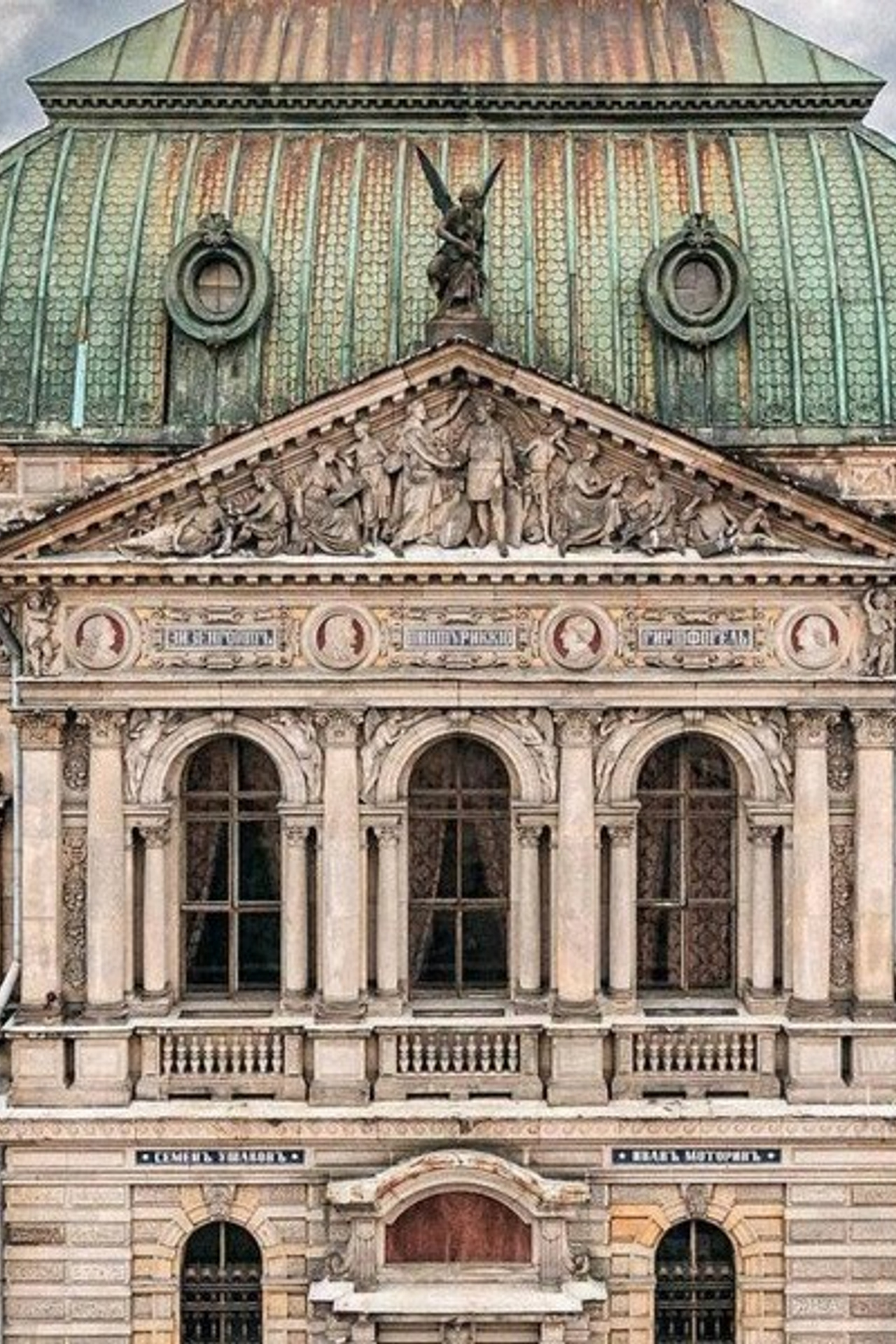
Empire is called the final phase of classicism (the first decade of the 19th century). The name comes from the French “empire” — empire; this is the style of Napoleon Bonaparte’s empire, practically a copy of the decorative elements of the Roman Empire. If rocaille moved away from the pomposity of Baroque, then Empire disregarded the restraint of classicism.
The features of Empire style are relief details in the form of clearly defined palmettes, lion masks, griffins, sphinxes, Egyptian motifs, or various military‑themed emblems (spirals, shields, arcs, eagles). From floristry — garlands, laurel and oak leaves, ears of grain, and sheaves. A style of confident grandeur within the framework of artistic harmony. It is no coincidence that Empire style was repeatedly (and almost universally) adopted by a wide variety of rulers.
The fashion of this period developed in contrast to the lavish, excessive fashion of 18th‑century Ancien Régime among the French aristocracy, to which no one wanted to be associated after the French Bourgeois Revolution. People began to dress with a greater degree of self‑expression than before, rather than with the previous desire to indicate their social status. Crinolines and wigs, corsets disappeared. The natural need to live in harmony with the surrounding world, promoted by the Enlightenment era, contributed to the emergence of a new costume, and the focus on Ancient Greece and Rome led to imitation of ancient fashion.
Women’s costume
The classic Empire style in women’s clothing is characterized by:
· Modest decoration of outfits
· Universality
· Light fabrics
· Neutral color scheme
Light shades were popular, indicating a high status; white, almost sheer fabrics and muslin were in demand. They learned how to bleach the fabric. The materials used were light cotton and linen fabrics — muslin, batiste, muslin, furlan, lace, crepe, tulle, and transparent wool — haze.
During the same period, women’s wardrobes were enriched with jackets and vests — they had migrated from men’s fashion. Riding coats adapted for everyday wear were also used. For walks, spencers (short jackets with long sleeves that gradually made their way into women’s fashion from men’s double‑breasted jackets) and riding coats (coats made of lightweight woolen fabrics with a fitted silhouette) were widely popular. The ladies’ outfit was completed with long gloves, a small umbrella, a purse‑like bag, and a fan.
Men’s costume
The French bourgeois revolution formally abolished class inequality, including in clothing. The fashions dictated by the court gave way to bourgeois fashions, the main element of which was outward uniformity. The male suit of the 19th century is, in principle, a business suit. If in previous centuries a suit was used to emphasize idleness and laziness, now a suit expresses the energy and businesslike nature of a person of the new era. Class status is now determined by the presence of fashionable outfits, their quantity, the decorations they feature, and the sophistication and elegance of the cut that distinguishes the lines of a suit tailored by the best craftsmen.
During the Empire period, men wore white shirts with a high, stiff, starched collar, short, colorful waistcoats, and a tailcoat. The waist of the tailcoat was slightly raised; the sleeve, which widened at the shoulder, had a funnel‑shaped cuff, and the velvet collar was a different color from the main fabric. The buttons were porcelain, silver, or made of precious stones.
Men wore neckerchiefs, which they tied in a bow or a knot, and tucked the ends under their waistcoats. Pantaloons were always lighter in color than the frock coat. They extended to the ankle, were held up by suspenders, and at the bottom had gaiters. Riding was still done in a riding coat, which a little later turned into everyday clothing — a “surtout.”
Initially, the frock coat served as something like a modern coat: it was worn over a uniform or tailcoat. But later, the frock coat began to be worn instead of a tailcoat. It was tailored to the waist, the skirts reached to the knees, and the sleeves were the same as those of a tailcoat. A waistcoat must be worn under a tailcoat. Suspenders are also an important part of a tailcoat suit. They are worn under the waistcoat. In the early years of the 19th century, the tailcoat had a very high stand-up collar, but since 1804-05, its height has been noticeably decreasing. In the men’s suit, unlike the previous one, the 18th century, it was not the luxury of decoration that was valued, but the quality of the fabric and tailoring. The color scheme and silhouette of the costume have become more restrained and concise.
The male suit did not undergo such drastic changes as the female one. After 1810, the frock coat gradually began to take its place. But it was only in the 1840s that the tailcoat finally disappeared from everyday use, retaining its role as formal attire. Around 1815, the carrick with several capes was very popular among ladies; in general, at that time, men’s‑style outer garments were preferred, and the style chosen was always the one that was currently in fashion among men. In the early 19th century, a pleated jabot was worn with a court costume together with a white tie, a shirt collar turned up, and pleated cuffs. The middle class used the jabot only in rare cases, but the nobility wore it in society and on the street until 1820. Also, around 1801, the complete absence of underwear was considered a sign of elegance. Therefore, the tie was wrapped tightly around the neck several times until it reached the very ears and chin, after which its ends were tucked behind the vest, into the neckline.
The costume I chose is a print from one of the pages of the Polish magazine “Women and Fashion” (“Journal des Dames et des Modes”), which was published from 1797 to 1839. Until the 1820s, the magazine held an almost international monopoly as a channel for spreading French fashion around the world. The description of the print was as follows: a tulle hat decorated with satin “rolls, ” lilac, and primroses. A velvet spencer decorated with gold braid. A dress made of percale with a pattern and muslin stripes. White gloves. Lilac-colored shoes. May, 1822.
Costume Elements
· Spencer. For the construction, thicker fabrics with lining were used: cashmere, cotton, silk, velvet. First of all, the style of the dress with a highly elevated waistline required a similar cut for the other items as well; otherwise, the overall fashionable silhouette would be disrupted. And the significantly shortened jacket perfectly complemented the main outfit. In addition, the cozy solid‑colored spencers — and they were made from silk or wool fabric dyed in bright colors — beautifully accentuated the light‑colored dresses. And finally, the spencer with long sleeves allowed ladies in light dresses with short sleeves to keep somewhat warm in cool weather.
· Frock dress: short sleeves, loose fit, high waist right under the bust, light shade and a fine embroidered pattern, long sleeve. The high waist divides the figure in a 1:6 ratio. Also, instead of a dress, a petticoat could be used.
· A hat with floral decorations and ribbons made of dense synthetic felt, covered with cotton fabric. The diameter of the base is approximately equal to the height of the crown. Maximum width.
· Collar. Initially, the ruff was attached to the collar, but later it became an independent element of the wardrobe that could be detached. The purpose of the ruff was to emphasize a person’s social status, their importance, and their wealth. Even the inconvenience of the collar had a special purpose. If a person could afford to wear a ruff, it meant they didn’t need to perform the tasks of an ordinary worker. The wide lace collar even hindered eating — its wearer could only eat with cutlery, thereby demonstrating knowledge of etiquette. As a rule, the collar was made of fine linen fabric (cambric), which was pleated with intricate patterns. Venetian lace was used less frequently. The starched material was pressed and dried using a brazier with coals: in appearance, it resembled a frying pan, and in function, it was like an iron. Then, a metal frame was inserted inside the entire structure, and the folds began to be created.
· Silk gloves
· Silk umbrella
· Silk handkerchief
Articles

The book that brought together nearly half a century and described almost the whole truth


One’s attitude toward the body as an interaction with the world