The Middle Ages is a period in history, primarily of Europe and the Middle East, that follows the Antiquity and precedes the Modern Era.
The Middle Ages are conventionally divided into three main stages: The Early Middle Ages (5th–10th centuries) — a time of the decline of ancient culture, the great migration of peoples, and the formation of new states. The High Middle Ages (11th–13th centuries) — a period of the flourishing of chivalric culture, the Crusades, and the development of cities. The Late Middle Ages (14th–15th centuries) was an era of crises, epidemics (such as the Black Death), and the emergence of the prerequisites for the Renaissance.
The Middle Ages were precisely a transitional era: first, we see fashion feeling its way, going back, and, with some changes, returning to forgotten forms. Roman costume, first modified by Byzantium, streamlined, and made in a semi‑Eastern style, returns. And suddenly, at the dawn of the 13th century, when new times begin to emerge from the twilight of old barbarism, a completely new fashion appears. This is the true birth of French fashion, purified of imitations, borrowings, and memories of Rome and Byzantium.
During the early Middle Ages, the ideal of female beauty was based on the church ideal. A woman was supposed to be devoted, gentle, fragile, with a slender waist and fair skin, golden hair, light eyes, beautifully defined bright lips, and cheeks the color of a delicate rose. A cult of the “beautiful lady” emerged — a lady whom knights worshipped, for whom tournaments were held, and who was glorified by troubadours. The woman was at the center of court life.
Realistic features became much more prominent in Gothic art, which spread throughout Europe during the High Middle Ages. In fact, the name “Gothic” is условное. It was synonymous with barbarism in the view of Renaissance historians, who were the first to use this term, characterizing the art of the Middle Ages as a whole and failing to see its valuable aspects. After the concept of “Romanesque art” emerged in the 19th century, Gothic came to be used to denote the final stage in the history of medieval art in Western Europe — from the end of the Romanesque period to the beginning of the Renaissance.
Gothic was born out of the dynamic processes in the life of the medieval world that marked the second half of the 12th–14th centuries. This was the time of the apogee in the development of feudal society in Western Europe. In the 12th–13th centuries, the consciousness of the ruling class of feudal lords was finally formed, and the Catholic Church reached unprecedented power, claiming dominance over the entire Western world.
The 13th century is marked by intense class struggle, which leads to class differentiation even in clothing. The stratification within the feudal class itself becomes more noticeable, and this is reflected in the clothing of the nobility. The clothing of feudal lords, townspeople, and peasants differs even more sharply. In the 13th century, the first laws are issued that limit the opulence of vassals’ clothing compared to that of their overlord. Laws appear that regulate the wearing of clothing depending on one’s social class. They prescribe strict restrictions on the choice of fabrics and the form of costume for different classes of society. For example, burghers, unlike nobles, were not allowed to wear silk clothing, long trains, etc.
A healthy realism was gaining strength in life and customs, in art and culture; at the same time, the hitherto humble piety gave way to dreamy asceticism, religious fanaticism, and ideological quests, which manifested themselves in various heresies. At the same time, as the art of sewing developed, the technology of clothing manufacture became more complex. In Western European clothing, and above all in France, a genuine “dominance of the scissors” begins: the foundations of cutting are laid, which had a particularly significant impact on the transformation of women’s clothing forms. The ability to cut fabric eliminated the dependence of clothing design on the width of the loom.
What previously barely dared to manifest itself — the accentuation of certain body shapes through changes in silhouette, the contrast between partial exposure and envelopment — is now unequivocally achieved through clothing, that is, “fashion” in the modern sense emerges. For the first time, sewn‑in sleeves appear in costumes; they are initially sewn on for one day and then taken off in the evening, since the clothing is very tight and it is impossible to take it off any other way. Sometimes the sleeves are tied with laces. Since the upper garment, which was previously put on over the head, has now become so narrow that it had to be cut in the front and equipped with fasteners, the latter acquired exceptional importance for the first time. With the invention of fasteners and the appearance of open‑front clothing, that is, clothing cut from the top to the bottom in the front, sleeves began to be sewn in for constant wear. A collar appears in the suit. The complexity of the cut allows for the division of volume, thereby enabling the creation of a suit that accentuates the figure.
The clothing for royal ladies and noblewomen consisted of many layers. Their undergarments were made of breeches, sleeves, and chemises and were covered with an under skirt made of linen or silk. Over the skirt was a long dress that flowed behind the noblewoman, and this dress was covered with a luxurious tunic. Inside the castle, special castle boots were worn, and a second set of footwear made of wood and leather was put on for walks outdoors. The women’s costume, like the men’s, consisted of two tunics worn one over the other; these tunics were long, reaching to the ankle. Under the lower tunic, a linen shirt — a camisia — was worn. The tunics were called a cotta and a surcote. The sleeves of the cotta were long and narrow; those of the surcote were sometimes short and wide, and sometimes they were absent altogether. The surcote was belted with a belt that descended to the hips. In the Middle Ages, plant fibers such as flax, hemp, and cotton, as well as wool, sheepskin, and animal fur, were used to make clothing. Silk, satin, satin, and taffeta were also used. More expensive fabrics were considered to be:
1. Wool is the most expensive fabric material
2. Worsted fabrics are woven materials
3. Felt is felted fabric
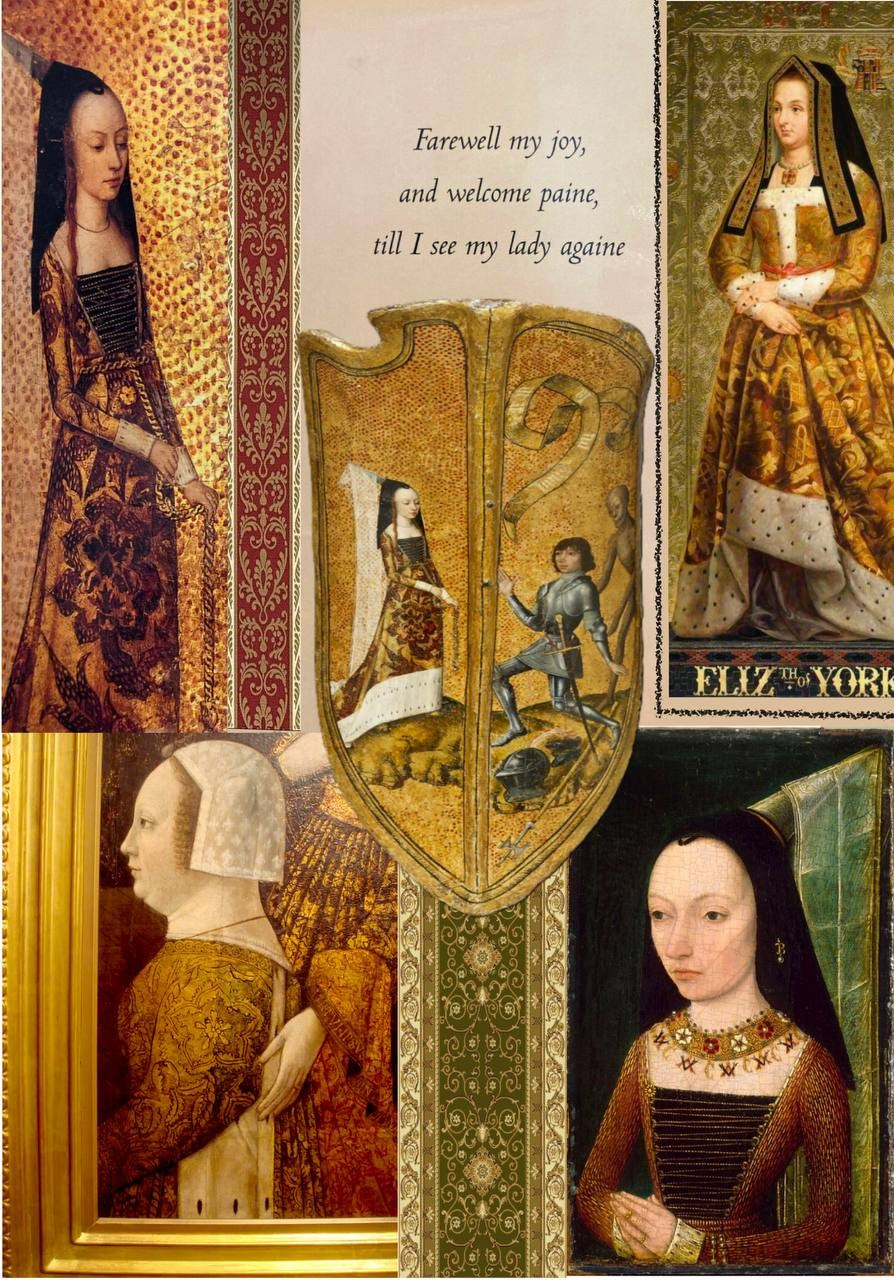
The costume that inspired me is depicted on the “Parade Shield” — a Flemish artifact from the 15th century depicting a scene of chivalric love, which is currently kept in the medieval gallery of the British Museum. On the front panel of the shield is a young knight dressed in battle armor. Kneeling in reverence to the woman he loves, he clutches a pole axe in one hand, and at his side lies a sheathed sword. The figure of Death appears from behind and glares at him angrily, reaching out to grab the knight. On the left side of the shield stands a noble lady, radiating arrogance. She is dressed in a luxurious garment, the gilded decorations of which shimmer in the light. She has a long ennen on her head, and a silk veil falls behind her.
Interestingly, the expression on her face conveys a sense of detachment, which makes her seem somewhat cold or dismissive of the dramatic scene unfolding before her. Above the knight’s head hovers a scroll with the words “you or death.” These words indicate that this is a scene of chivalric love, in which the knight will gladly die to prove his love, thereby dishonoring his lady and losing her love due to his unsuccessful actions in battle. From this description alone, it becomes clear that this costume embodies the cruelty and cold‑bloodedness of the era.
This costume is also depicted in an illustration for one of the most famous works of the Middle Ages, “The Romance of the Rose.” The last lines of the novel on the page with the illustration read: “Farewell, my joy! Greetings, sorrow, Until I see you again!”
The portrait of Margaret of York from 1458 allows for a more detailed examination of a similar costume from the Middle Ages. From it, one can see that the waist of the dress is slightly raised, the lacing on the chest is connected in a consistent and symmetrical manner, the neckline lines are straight, without any curve, and of a simple shape; the sleeve is a set‑in type, almost form‑fitting, extending slightly to the palm of the hand; the hanging part of the ennen is slightly below the shoulder line; the headdress smoothly frames the forehead line. It appears that the costume I have chosen belonged to an Englishwoman of noble status. This is indicated by the luxurious headdress worn by married women, the rich fabric of the dress with a fur border at the bottom, and some of the jewelry.
The whole costume consists of 6 elements: Underwear — breeches and Camisa shirt — shelf shirt Tunic — surcoat Top dress with belt Shoes made of wood and leather, a low conical headdress, and underwear, a camisa, and a tunic could be sewn from inexpensive woven materials, such as linen.
The outer garment was most likely made of damask — (dam, kamka, kamchatka) — a fabric (usually silk), single‑ or double‑faced, with a pattern (usually floral) formed by a shiny satin weave of threads on a matte plain weave background. Starting in the 12th century, the fabric was brought to Europe from the East. Later, around the 16th century, it began to be produced in Europe.
Ennens were usually made of cardboard or wire mesh, over which a light fabric was attached. The height could be 30 or 50 cm, and for queens and princesses — up to a meter. A light veil is draped over the ennen and almost reaches the floor. A short loop at the front of the ennen served to adjust or hold the ennen in the wind if necessary. The fabric of the veil resembles tulle. Veils were made of thin, loosely woven silk or gauze.


One’s attitude toward the body as an interaction with the world



The book that brought together nearly half a century and described almost the whole truth